When the Door is Closed
Welcome to my random musings about the world, on a weekly-to-occasional basis.
Where we are: Today we’re in Tatev, Armenia. We’re on a very brief road-trip to a couple of spots we wanted to see in the countryside—next up is Lake Sevan. Earlier this week we had a little detour in Aktau, Kazakhstan for a few days; it would’ve made more sense to fly directly from Azerbaijan to Armenia, but they do not get along at all, thus there are no flights between the two neighbors.
When the Door
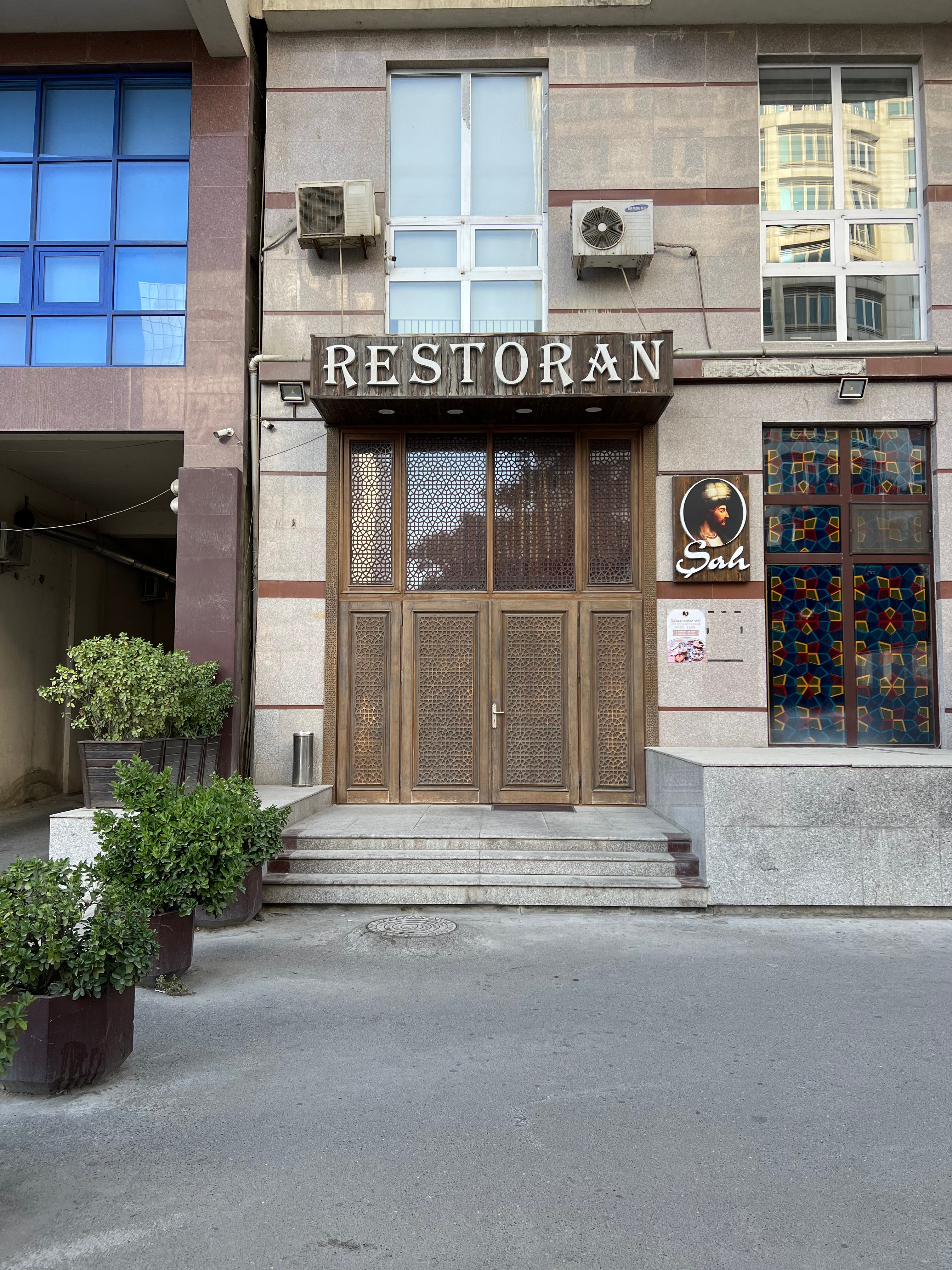
On our first day in Baku, we used Lee’s (mostly) trusty restaurant-picking system for lunch: we asked the Google map what was nearby, open, and highly rated.
That’s how we found Restaurant Shah, but we almost didn’t.
The photo above is the front door. Can you see why we almost walked right past it? It didn’t have that warm, welcoming, come-on-in and have lunch vibe that we’re used to seeing in a restaurant facade. It didn’t even look open—even once we realized those wooden doors were the establishment we were looking for, we assumed it was closed. My initial pang of disappointment was strong—I was hungry, it was hot, and I wanted some (highly-rated) Azerbaijani food.
Luckily, one of the lessons we’ve learned over the last nine years (having had it hammered into our brains repeatedly—we’re slow learners) is that appearances can be deceptive. We can’t always read the cues.
I emphasize the previous sentence because it has been so, so important in our peripatetic years. At this point, I just assume that no matter how observant I am, or how hard I try, I understand nothing. If all I have to go on is my own intellect/experience/senses, I simply can’t understand what the subtle social cues are in a culture that is not my own.
You know how you have that spidey sense that tingles when you accidentally get off the interstate at the wrong exit, and you’re stuck at a traffic light, and you look around and think, ‘I need to get back on the highway right now’?
You can’t count on your spidey sense when you’re in a foreign country—it’s pretty much always wrong. In the early days of traveling, mine was on high alert most of the time—I was suspicious and paranoid and convinced I had strayed into a bad neighborhood, or someone was following me, or the restaurant was closed, or the cashier was yelling at me, or the people were unfriendly. I was wrong, every time. Every time.
Take Beirut: pretty much the whole city looks like a bad neighborhood. There are some beautiful shopping areas, but they’re mostly empty, and there’s some extraordinary architecture, but its extraordinariness is mostly because it’s in the middle of Beirut, which is a former war zone that hasn’t been able to patch the bullet holes and clean itself up. The socio-economic cues that jumped out at me were bad neighborhood, bad neighborhood!
We were there at the height of the Syrian refugee crisis, which added an extra layer of desperation to the vibe, but as I ventured out more and more each day, I discovered a city that was warm and welcoming, full of kind, friendly people doing their best with the really shitty hand they’d been dealt.
We went on a food tour one day, and got to be friends with the guide. She invited us over for tea a few days later. We found her neighborhood, which looked, of course, a little sketchy (to our American eyes), and when we found her perfectly ordinary, slightly shabby looking apartment building, we braced ourselves to enter a potentially creepy/awkward situation. But then she opened the door, and we were in the most beautiful home I’ve ever seen, bar none. It was breath-taking. I am not exaggerating. She and her husband had amassed a spectacular, thoughtful collection of modern art, and the pieces were exquisitely displayed. No detail had been overlooked, from the lighting, to the comfort of the furnishings, to the wooden fretwork and the chased silver teapot.
We could have been freaked out by the ‘cues’ that would be so off-putting in our own culture. And to be fair, sometimes it’s hard, even now, to remember that I probably don’t understand what I’m seeing. Lee and I have to constantly remind each other not to make assumptions. I remind myself, when I’m alone, that things are not always as they appear and the world is probably not out to get me. More often than not, I learn something new or meet someone wonderful or at least have a memorable experience.
Last week in Baku, when we finally saw the door of Restaurant Shah, my brain reflexively started down the hangry path. We almost walked away without even trying the door. I am so, so glad we didn’t—our lunch was extraordinary. In fact, it was so good we went back a second time and have already recommended it to a friend.
Social cues are great when you’re on familiar territory; otherwise they’re pretty useless. Unfortunately, they’re so deeply engrained, they’re hard to ignore.
Take care,
Lisa
P.S. Thanks for reading, and feel free to share. If you have feedback, I’d love to hear it. And if someone forwarded this to you, thank them for me, and go to https://bookwoman.com/ to subscribe.