It’s All About the People
Welcome to my random musings about the world, on a weekly-to-occasional basis.
Where we are: We’re in Dhaka, Bangladesh; tomorrow we’re heading to Nepal.
It’s All About the People
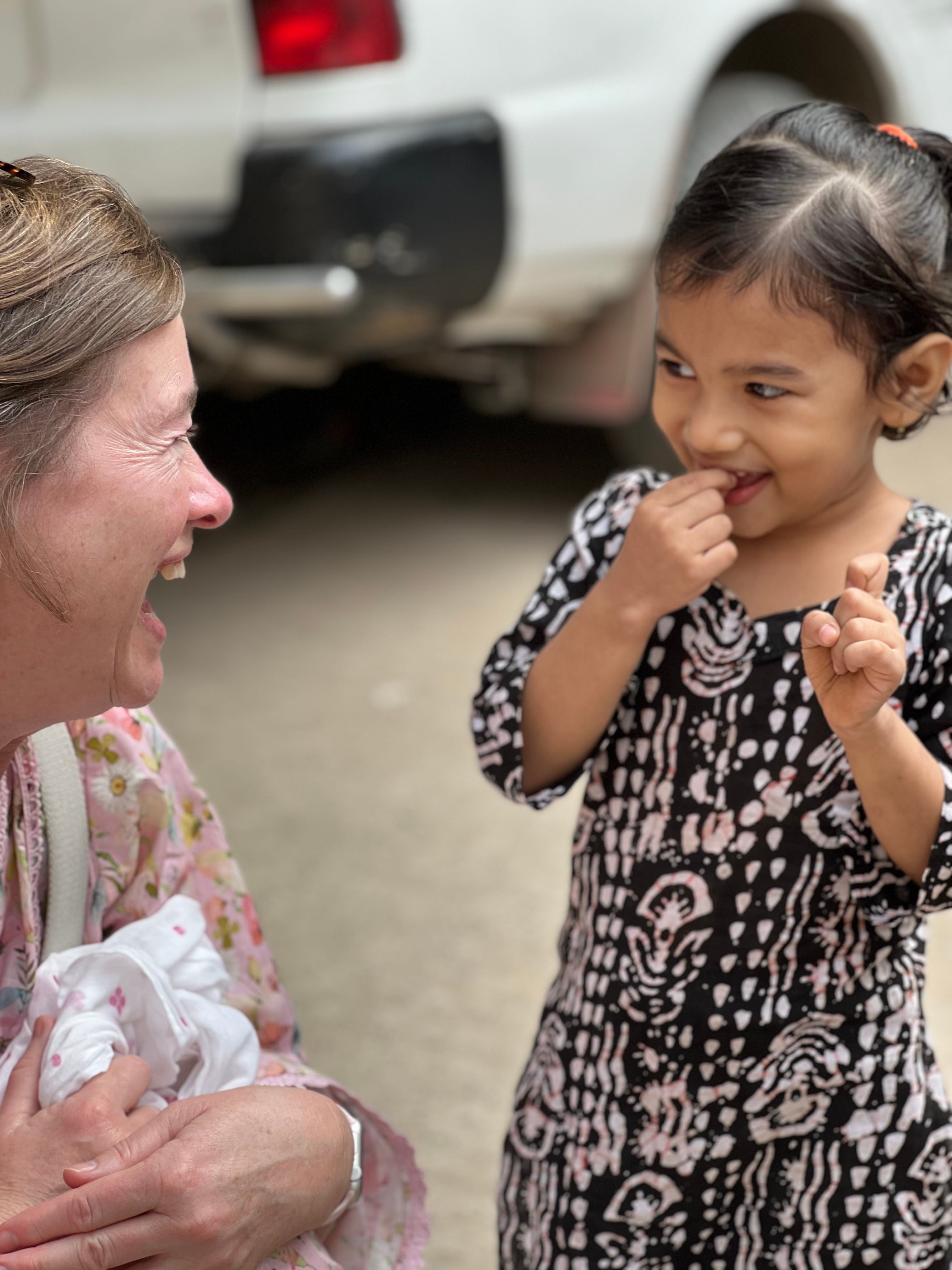
For the last five days, we’ve been in Dhaka. Several years ago, Lee read that Dhaka is the most densely populated big city in the world, so obviously we had to see it for ourselves. It is definitely interesting.
There’s little-to-no tourism here, so we are a bit of an oddity. Also, we are a middle-aged white couple, which makes us even more unusual. On Wednesday we went on a tour of the city, with a guide and driver, and everywhere we went, moms asked me to pose for photos with their children. SO MANY PHOTOS. Lee asked me what it was like to be a minor celebrity; luckily, I love children, so it was great fun.
But it was also a day of seeing the tiniest glimpse of the reality of life in a developing country. The poverty here is intense. There’s litter everywhere, people everywhere, stray dogs everywhere—the general filth is inescapable. I saw signs advertising a government program to end leprosy by 2030. That’s the kind of thing that rocks me back on my heels, hard. I can’t tell you the profound, existential privilege I feel, knowing that in my 56 years of life, I’ve never once had to worry about leprosy.
The air is appalling—pollution is one hallmark of a developing country building industries to provide cheap goods for wealthy countries. In Dhaka, a thick yellow haze filters the sun. My eyes are prickly, my throat is sore, and my skin is developing itchy irritated patches. That’s the kind of environmental hazard that is unavoidable—wealthy people can get air filters, but eventually even their children will go outside. Poor air quality does brutal damage to tiny lungs; perhaps that’s why I, at 5’5” tall, tower over most people here. I was privileged to grow up with clean air and clean water and enough to eat.
There was a war here in the mid-70s; it’s difficult to say how many died, but somewhere between one and three million people. That was fifty years ago, but within my lifetime. I think the worst of it was in Dhaka. I sit at the breakfast table in our hotel, looking out the window at rickshaws and tuktuks and the decrepit busses of the transit system, and can’t imagine. The garbage is bad, but to think what it was like when these streets ran with blood? I can’t imagine.
Nowadays the streets are full of traffic. There are plenty of private cars, but as far as I can tell, most ordinary people get around by bus or rickshaw, which is basically a pedicab, powered by the sinewy strength of a scrawny old man wearing a longyi. More than once we’ve been stuck in total gridlock, surrounded by nothing but pedicabs, every one of which has a shrill bicycle bell that they are not afraid to use. It is a cacophony.
People beg. They tap on the car windows when we’re stuck in traffic, cupping hands around their eyes to peer in at us. They are persistent, tapping and tapping and tapping and tapping, as long as it takes for traffic to clear so we can move on to another intersection, another beggar.
Hunched, wrinkled old ladies clutch at my arm on the street, gesturing to their mouths in the universal signal of hunger. They are even smaller than my tiny mother, but I suspect they are younger by a good many years. A hard life—a revolution—ages a body. The first time one touched me, I was surprised, but I quickly got used to it. In a place with this many humans jammed together, ‘personal space’ is an unaffordable luxury.
There’s a dengue outbreak happening, so our hotel employs young men to wander around with handheld bug zappers. Lee and I wear mosquito repellent, because that’s another luxury we are lucky enough to be able to afford.
But Lee got to breakfast before I did this morning, and texted me: “I really question if we have ever met nicer people.” He’s right. Everyone we interact with is over-the-top nice. They want desperately for us to like their city, their country, their food, their hotel. I went out the first day and bought two outfits (shalwar kamiz; google if you want to know what they look like) so that I’d be modestly dressed, and the approval and appreciation are almost overwhelming. I was just trying to be polite, and people act like I’ve awarded the whole country a prize.
And perhaps I have. Isn’t that ultimately what we all want—to be acknowledged and respected? To have the world look at us and say yes, you are good enough to be one of us? To be seen?
Take care,
Lisa
P.S. Thanks for reading, and feel free to share. If you have feedback, I’d love to hear it. And if someone forwarded this to you, thank them for me, and go to https://bookwoman.com/ to subscribe.